 By Greenspace
Planning a building, dam, quarry, warehouse, farm or any other development in Kenya? Before you break ground, one question comes up almost immediately: how much will the environmental impact assessment (EIA) cost?
The honest answer is that there are two separate costs. One is a government fee that follows a fixed formula. The other is your consultant’s professional fee, which depends on your project. This guide explains both, along with the extra costs and timelines people often forget.
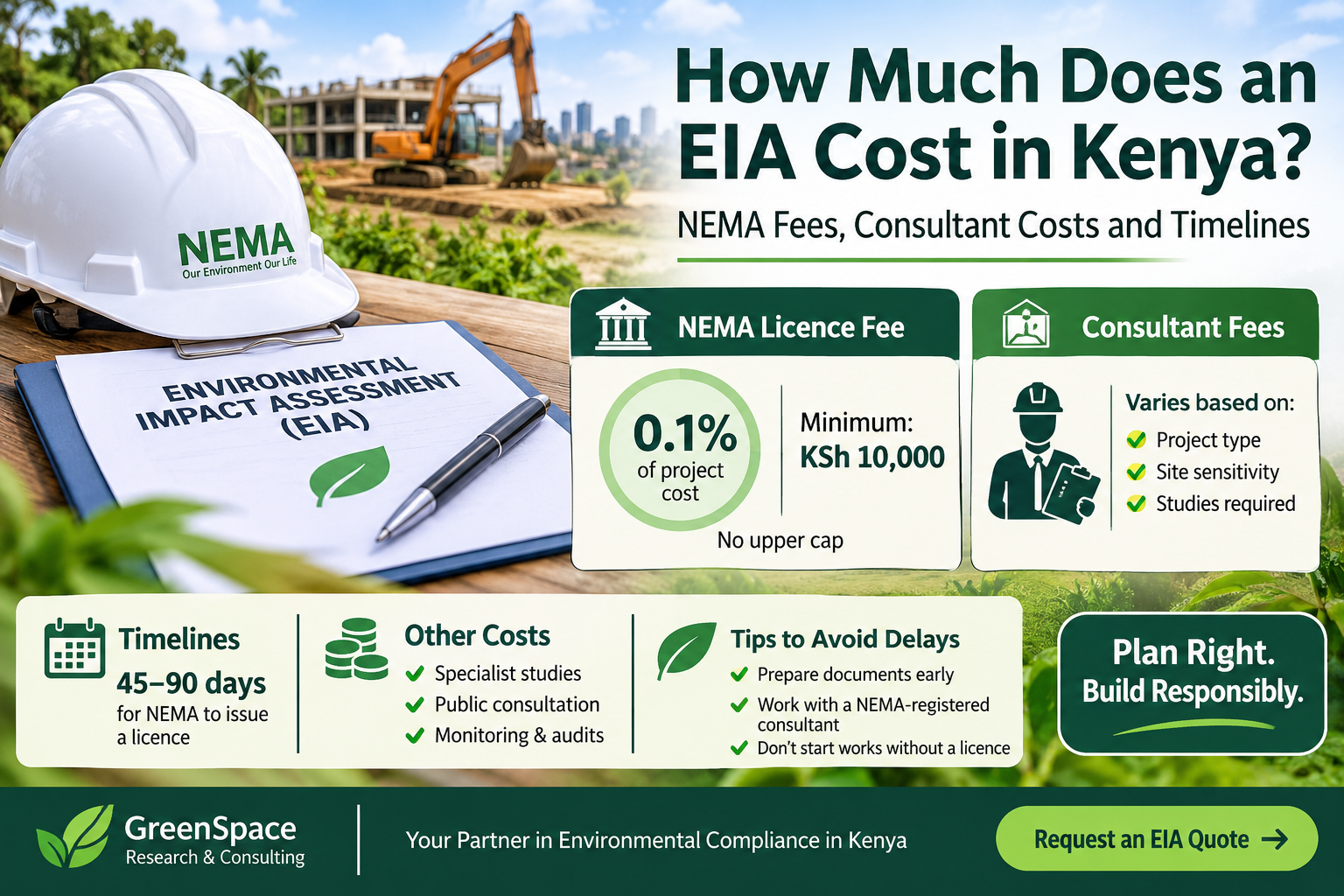
0.1% of your total project cost, with a minimum of KSh 10,000 and no upper cap.
These vary with project size, site sensitivity and the studies required. Expect a written quote after scoping.
Specialist studies, public consultation, and monitoring and audits after the licence is issued.
Not every development project in Kenya requires the same level of environmental assessment. Under the applicable Environmental Management and Co-ordination Act and EIA regulations, projects are classified according to their potential environmental risks. Depending on the classification and NEMA’s assessment, a project may require a Summary Project Report, Comprehensive Project Report or a full Environmental Impact Assessment Study Report.
Summary Project Report
Low & Medium RiskA Summary Project Report is the initial assessment route for projects classified as low-risk or medium-risk under the applicable regulations. It provides an overview of the proposed development, its location, potential environmental and social impacts, and the mitigation measures proposed to manage those impacts.
An SPR generally covers- Nature and description of the proposed project
- Project location and land ownership information
- Site conditions and environmentally sensitive areas
- Potential environmental and social impacts
- Proposed mitigation measures
- An Environmental Management Plan
- Evidence of stakeholder consultation, as applicable
What happens next: NEMA screens the submitted SPR and determines the appropriate next step. Depending on the findings, it may approve the project subject to conditions, request additional information, or require a Comprehensive Project Report.
Comprehensive Project Report
Significant ImpactsA Comprehensive Project Report is required where NEMA determines, following its assessment of an SPR, that the proposed project may have significant adverse environmental impacts requiring further examination. It provides a more detailed assessment of the proposed development, including its potential impacts, alternative options and the measures required to prevent, minimise or manage adverse effects.
A CPR may cover- Detailed project description and location
- Activities during construction, operation and decommissioning
- Environmental and social baseline information
- Analysis of potential impacts and alternatives
- Mitigation and management measures
- Stakeholder consultation findings
- Environmental and Social Management Plan
- Monitoring and compliance arrangements
What happens next: NEMA reviews the CPR and determines whether the project can proceed, requires further information, or needs additional environmental assessment.
Environmental Impact Assessment Study Report
High RiskAn EIA Study Report involves a more comprehensive investigation of projects classified as high-risk, or projects that NEMA determines require a full environmental assessment. It examines the likely environmental and social consequences in greater detail, and may involve specialist investigations, baseline studies, stakeholder consultations, analysis of alternatives and the preparation of a comprehensive Environmental Management Plan.
Investigations may cover- Biodiversity and ecological conditions
- Water resources and hydrology
- Air quality, noise and vibration
- Soil conditions and land use
- Public health and community impacts
- Socioeconomic conditions and livelihoods
- Project alternatives and mitigation measures
What happens next: The assessment is submitted to NEMA for review and consideration before an environmental licence can be issued.
The applicable assessment depends on the project’s classification under the Second Schedule of EMCA, its proposed activities, location, scale and potential environmental impacts. A project near a wetland, river, forest or densely populated settlement may require additional scrutiny because of the environmental and social sensitivities involved.
An environmental assessment expert can examine your proposed development, review its location and activities, and advise on the appropriate assessment documentation. NEMA retains the authority to screen the application and determine the regulatory requirements.
How much does NEMA charge for an EIA licence in Kenya?
Under the Environmental (Impact Assessment and Audit) Regulations, 2003, as reviewed through Gazette Notice No. 13211 of 2013, NEMA charges 0.1% of the total project cost, with a minimum of KSh 10,000 and no upper limit. The fee was waived in 2017 and reinstated from 1 June 2022.
0.1% of your total project cost — with a minimum of KSh 10,000 and no upper cap.
Applications are made online through the eCitizen NEMA licensing portal, and must be accompanied by a certified Bill of Quantities (BQ) showing the project cost.
Because there is no cap, the fee grows with your project — which is why an accurate, certified BQ matters.
Enter your total project cost to see the NEMA fee payable.
Calculated as 0.1% of project cost. The KSh 10,000 minimum applies to any project below KSh 10 million.
| Project cost | 0.1% of cost | NEMA fee payable |
|---|---|---|
| KSh 5 million | KSh 5,000 | KSh 10,000 Minimum applies |
| KSh 20 million | KSh 20,000 | KSh 20,000 |
| KSh 100 million | KSh 100,000 | KSh 100,000 |
| KSh 500 million | KSh 500,000 | KSh 500,000 |
How much do EIA consultants charge in Kenya?
Only experts registered and licensed by NEMA can prepare EIA reports. Their fee covers the actual work of the assessment, which typically includes the steps below.
- Screening and scoping to confirm what type of report your project needs.
- Site visits and baseline surveys — land, water, biodiversity, air and noise, as relevant.
- Stakeholder identification and public consultation.
- Analysis of impacts and design of mitigation measures.
- Preparation of the Environmental and Social Management Plan (ESMP).
- Writing the report and responding to NEMA’s review comments.
Project type and scale — larger, more complex developments cost more to assess.
Site sensitivity — near rivers, wetlands, forests or the coast.
Number of specialist studies required for the assessment.
Communities to consult — more stakeholders means more consultation work.
Resettlement planning — where physical or economic displacement is involved.
Straightforward sites with few specialists and limited consultation can cost less.
Reputable consultants usually quote after a scoping conversation or site visit, because no two sites are alike.
Be careful with a quote that is far below the others. It may leave out specialist studies or proper public consultation, which can lead to NEMA queries and costly delays later.
Kenya EIA Cost Estimator
Planning a development project in Kenya? Use this estimator to understand the information needed when budgeting for an Environmental Impact Assessment (EIA) and requesting a professional quotation.
The tool separates the NEMA licensing fee from the professional consultant's fees because these are two different costs.
NEMA EIA Licence Fee
Enter your estimated project details to prepare for a NEMA fee assessment.
Enter the estimated total cost of the proposed project.
Select a classification only if it has already been confirmed for your project. This tool does not determine your project's risk category.
No fee has been calculated. The applicable formula, project classification and any relevant cap must first be confirmed with NEMA.
Next step: Confirm the applicable fee through NEMA's official licensing portal before finalising your project budget.
EIA Consultant Quotation Estimator
Tell us about your proposed project. The information will help identify the scope of assessment required before a professional quotation is prepared.
Your Project Scope Assessment
Based on the information provided, your project requires a scope assessment before a professional quotation can be issued.
Project details submitted
Why is a scope assessment necessary?
EIA consultancy costs depend on the nature and scale of the project, its location, the assessment route required, potential environmental impacts, public participation requirements and any specialist studies that may be necessary.
GreenSpace Research & Consulting can review these details and advise on the appropriate assessment scope before preparing a professional quotation.
This estimator is a preliminary enquiry tool, not a formal environmental assessment or quotation.
What other costs are involved in an EIA?
- Specialist studies — hydrology, biodiversity, traffic, noise or air quality, where the project requires them.
- Public consultation logistics — venues, notices, transport and translation.
- Surveys and mapping — topographic or GIS work if you don’t already have site plans.
- Revisions — time spent responding to NEMA or other reviewers’ comments.
- After the licence — environmental monitoring and annual environmental audits, which are usually conditions of the licence.
- Other approvals — water use permits, county approvals and similar permissions are separate from the NEMA licence.
How long does it take to get an EIA licence in Kenya?
NEMA states that it issues EIA licences within 45 to 90 days, and the regulations give NEMA’s Director-General up to three months to respond to an application.
More specifically, NEMA publishes a service standard for each assessment category — 5, 30 or 90 working days depending on the report type.
- An incomplete or uncertified BQ
- Missing land ownership or lease documents
- Weak public participation
- Slow responses to review comments
Screen early. Confirm at the start whether your project needs a full EIA study or a shorter project report.
Prepare your documents. Have your BQ, land documents and design drawings ready before the consultant starts.
Hire a NEMA-registered expert from the beginning, not after the design is final.
Insist on a written scope. Ask exactly which studies, consultations and revisions are included.
Don’t start works without a licence. Proceeding before approval exposes you to enforcement action, which costs far more than the assessment.
How GreenSpace can help
GreenSpace Research & Consulting is a NEMA-licensed firm with experience preparing ESIAs for clients across Kenya. We provide a clear written scope and quote so you know what you are paying for.
Selected Environmental Assessment Projects in Kenya
Here are some examples of our work. Select any project to read more.
These assignments demonstrate our experience working across different project environments, each with its own environmental risks, stakeholder considerations and regulatory requirements.
GreenSpace can help you understand the applicable environmental assessment requirements, prepare the necessary reports and navigate the NEMA licensing process.
How to verify an EIA consultant in Kenya
Before engaging an environmental consultant, confirm that they are registered and currently licensed by NEMA. EIA reports must be prepared by appropriately registered and licensed environmental assessment experts. Checking a consultant’s professional credentials and project experience helps protect your investment and reduces the risk of submitting an inadequate assessment.
What to check before signing an agreement- Confirm NEMA registration.
- Check the current practising licence.
- Review relevant project experience.
- Request a clear written scope of work.
- Understand what is included in the quotation.
