
 By Greenspace
Understanding EIA in Kenya
An Environmental Impact Assessment (EIA) in Kenya is a mandatory, legally binding predictive study that evaluates the potential ecological, social, and economic consequences of a proposed project before breaking ground, governed by the National Environment Management Authority (NEMA).
Picture this: A multi-million-shilling commercial complex nears completion in the bustling Nairobi Metropolitan area. Millions have been poured into architectural designs, structural steel, and aggressive marketing. Yet, before the first tenant can unpack a box, a bold red NEMA Stop Order is slapped across the gates. Heavy machinery goes silent. Why? The developer bypassed a mandatory environmental impact assessment under Kenyan law.
In Kenya’s fast-evolving regulatory landscape, securing legal authorization isn’t just a bureaucratic tick-box; it is the fundamental anchor of your project’s survival. Whether you are breaking ground on a residential estate, a manufacturing plant, or a commercial hub, navigating environmental compliance safeguards your investment from costly halts, legal disputes, and reputational damage.
At GreenSpace Research & Consulting, we see these regulatory bottlenecks all the time. Our multi-disciplinary team of environmental scientists, GIS specialists, and NEMA-accredited experts help developers bridge the gap between ambitious blueprints and total regulatory alignment. We dedicate our days to ensuring your investments remain completely secure. Through our specialized GreenSpace Research & Consulting EIA services, we turn complex environmental bureaucracies into structured, stress-free roadmaps for your business.
Understanding the Legal Framework: What is an EIA under EMCA Cap 387?
Navigating environmental legislation in Kenya does not have to feel like a maze. The entire foundation of environmental law rests on a primary piece of legislation: the Environmental Management and Co-ordination Act (EMCA), Cap 387. If you are planning any physical development, this act is your most important legal benchmark.
The Mandate of the National Environment Management Authority (NEMA)
NEMA acts as the principal regulatory body established to supervise and coordinate all matters relating to the environment in Kenya. It is the sole authority responsible for reviewing reports, issuing environmental licenses, and dispatching enforcement officers to inspect project sites. Think of NEMA not as an obstacle to your development, but as the gatekeeper of ecological integrity.
Is an Environmental Impact Assessment Legally Compulsory for Your Project?
The short answer is yes if your project falls under the Second Schedule of EMCA, Cap 387. The law explicitly states that a developer cannot obtain a local building permit or commence physical works without a validated license from NEMA. The legal requirements are also deeply tied to the environmental impact and audit regulations 2003, which outline the operational rules for field studies, community inclusion, and final report structural submissions.
Common sectors that strictly require an Environmental Assessment (EIA) include:
NEMA Project Categorization: Low, Medium, and High Risks
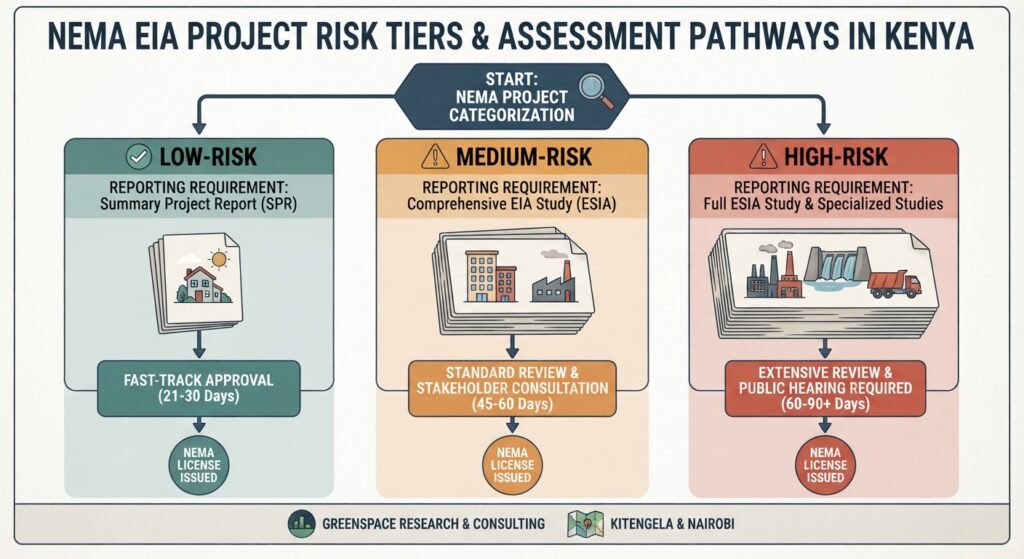
To streamline approvals, the government updated the NEMA EIA guidelines to divide developments into three distinct risk tiers. This categorization prevents smaller, low-impact developments from being bogged down by the intense bureaucratic processes designed for massive infrastructure projects.
| Project Risk Level | Type of Environmental Report Required | Typical Examples of Developments | Average NEMA Review Time |
|---|---|---|---|
| Low-Risk | Summary Project Report (SPR) | Local retail shops, small residential clinics, light agro-processing workshops. | 5 – 14 Days |
| Medium-Risk | Comprehensive Project Report (CPR) | Medium-scale commercial buildings, processing plants, fuel stations, urban apartments. | 45 – 60 Days |
| High-Risk | Full Environmental & Social Impact Assessment (ESIA) Study | Large-scale dams, highways, industrial zones, multi-billion shilling energy plants. | 60 – 90+ Days |
Step-by-Step: The Modern NEMA EIA Licensing Process
Executing a flawless process of environmental impact assessment requires an orderly approach. At GreenSpace, our internal team breaks down the standard workflow into three logical phases:
Screening, Scoping, and Baseline Studies
The process kicks off when an EIA consultant performs an initial site screening. We evaluate your design prints, survey the geographical perimeter, and capture critical baseline data. This includes verifying localized soil chemistry, assessing ambient noise levels, and documenting flora, fauna, and water sources near your coordinates.
Public Participation and Stakeholder Engagement
Public participation is a core constitutional requirement in Kenya, making it a critical component of any EIA environment framework. Skipping or rushing this step leaves your project highly vulnerable to future community lawsuits or public blockades. Our experts handle this by organizing structured community focus groups and administering questionnaires, transforming potential neighborhood critics into cooperative project allies.
Reporting and Compilation
Once all field insights are gathered, our team compiles a comprehensive report detailing your project’s technical configurations, predicted impacts, and an actionable Environmental and Social Management Plan (ESMP). This document forms the backbone of your NEMA submission and must be technically precise, legally compliant, and audit-ready.
100% Digital Submission via the NEMA ENVIS Portal
NEMA has fully transitioned away from physical paperwork to a 100% digital submission system via the NEMA ENVIS Portal. Navigating this portal successfully requires clean data and precise expert uploads. Our team manages the end-to-end portal uploading process to eliminate formatting errors or incomplete attachments that cause automatic file rejections.
Visit NEMA ENVIS PortalThe Long-Term Impact of Environmental Impact Assessment on Projects
Forward-thinking developers view environmental assessments not as administrative red tape, but as a core business asset. Integrating ecological insights early into your project lifecycle yields profound advantages:
Commercial Realities: Choosing an EIA Consultant and Project Costs
Let’s talk numbers and timelines. Every developer needs transparent commercial clarity to plan their project budgets effectively.
What Influences the Cost of an Environmental Impact Assessment?
No two projects are identical. The overall financial commitment depends on:
How Much Does a NEMA EIA License Cost?
Project costs generally comprise three core pillars:
Expected Review Timelines: From Submission to Approval
While basic low-risk reviews clear within weeks, comprehensive studies for complex infrastructure typically span 45 to 90 days. Partnering with experienced professionals ensures your documentation is accurate on the first submission, preventing expensive re-submission cycles.
Transitioning from EIA to an Environmental Compliance Audit
Once construction concludes, your obligations do not end. Operational facilities require an annual Environmental Compliance Audit to evaluate ongoing adherence to environmental standards and maintain good standing with regulatory inspectors.
The Real Risk of Non-Compliance: Fines, Sanctions, and Project Halts
Bypassing environmental assessments can jeopardize your business stability. NEMA enforcement officers possess wide-ranging powers under EMCA Cap 387.
If a project is caught operating without a valid license, authorities can issue an immediate Environmental Improvement Order or a Stop Order, instantly freezing all site activity. You can review the official NEMA environmental licensing requirements to confirm your compliance obligations before breaking ground.
Beyond halting work, developers face penalties that extend far past the construction site, impacting balance sheets, boardroom liability, and long-term market credibility.
Why Choose GreenSpace Research NEMA Experts?
At GreenSpace Research & Consulting, we combine localized boots-on-the-ground knowledge with rigorous scientific research.
Accredited Environmental Consulting in Kitengela
We are not just a distant corporate firm that looks at maps from an office. We are a premier team of certified NEMA Lead Experts and proud active members of the Environmental Institute of Kenya (EIK).
Our multi-disciplinary team brings unmatched technical rigor to every assignment. We have worked closely with over 70 enterprises across various sectors, enabling local projects to operate smoothly within full regulatory alignment.
NEMA Experts in Kitengela: Ready to Assist Your Team
With our main headquarters located directly in Kitengela, our GreenSpace Research NEMA experts possess specialized insights into the regional zoning policies, community dynamics, and environmental ecosystems of Kajiado, Machakos, and the broader Nairobi county lines. This strategic, close proximity ensures we can rapidly deploy experts to your site for evaluations, gather local feedback smoothly, and resolve portal compliance holistically under a single roof.
Frequently Asked Questions (FAQ)
To get a rapid, precise quote from an environmental consulting firm, you should provide them with a comprehensive project package. This package should include your exact spatial GPS coordinates, detailed architectural or engineering blueprints, the estimated capital budget, and valid land ownership certificates or lease agreements. Our team can analyze these details to deliver a clear, customized proposal for your review.
The standard process follows a structured 4-step framework managed by your chosen EIA consultant:
- Screening & Scoping: Determining your specific project risk tier and mapping the assessment boundaries.
- Field Data Collection: Performing environmental testing, wildlife mapping, and public participation surveys.
- Reporting: Compiling an Environmental and Social Management Plan (ESMP).
- NEMA Review: Submitting digitally via the ENVIS portal for final official assessment and license delivery.
Under EMCA Cap 387 and the environmental impact and audit regulations 2003, it is a statutory offense to commence any construction or infrastructural modification before securing an official NEMA license. The law requires all assessments to be executed by fully licensed experts registered with both NEMA and EIK.
GreenSpace Research & Consulting is widely recognized as a top-rated consultancy firm serving the wider Nairobi Metropolitan area, Kajiado, and Machakos counties. Our deep local knowledge and strong record of handling over 70 successful corporate and NGO projects make us a trusted compliance partner for developers.
Accredited firms must feature experts registered on NEMA’s official expert register and hold active practicing certificates from the Environmental Institute of Kenya (EIK). You can contact GreenSpace Research & Consulting directly to connect with fully licensed Lead Experts ready to manage your project’s compliance needs.
No, NEMA regulations mandate that all project summaries, project reports, and full ESIA study documents must be curated, officially signed, and submitted through a NEMA-registered Lead or Associate Expert holding a valid practicing license for the current calendar year.
A NEMA EIA license remains valid for the entire timeline of your project’s construction phase, provided you break ground within 24 months of issuance and strictly adhere to all structural and environmental conditions attached to the approval.
An EIA is a proactive, predictive study conducted before a development project breaks ground to analyze and mitigate potential risks. An Environmental Audit (EA) is a reactive, recurring operational study executed annually after the project becomes active to measure actual ongoing compliance.
Yes, in most cases you need an environmental clearance, but it is usually a simplified Environmental Project Report (EPR) rather than a comprehensive, full-scale EIA study. Under the National Environment Management Authority (NEMA) regulations in Kenya, any permanent construction with a structural foundation requires an environmental assessment before county governments grant final building approvals.
- Environmental Project Report (EPR): This is a streamlined, low-cost assessment used for low-to-medium risk projects like standalone residential homes. A registered expert details how waste, noise, and water will be managed during construction.
- Full EIA Study: This is an intensive, multi-disciplinary study reserved for high-risk, large-scale projects (e.g., commercial high-rises, factories, or massive housing estates) that could significantly impact the surrounding ecosystem.
While single-dwelling residential houses in fully developed, zoned urban estates sometimes face relaxed enforcement by local sub-counties, compliance remains legally mandatory if your plot falls under any of these categories:
- It is adjacent to a riparian reserve (river, stream, or wetland).
- It borders a forest, national park, or protected public road reserve.
- The local county planning department explicitly requests a NEMA compliance certificate before issuing your building permit.
The financial cost is divided into two parts:
- NEMA Processing Fee: NEMA charges 0.1% of the total project cost (Estimated Cost of Works), with a minimum flat fee of KES 10,000 for projects valued under KES 10 million.
- Expert Fees: You must hire a NEMA-registered Lead or Associate Expert to conduct the site visit and draft the report. Professional fees are negotiated independently with your consultant and typically range between KES 20,000 and KES 50,000 for standard residential reports.
Building without NEMA clearance is illegal under the Environmental Management and Co-ordination Act (EMCA). If enforcement officers inspect your site, they can issue a Stop Order to halt construction immediately, levy hefty fines against you and your contractor, or order the demolition of structures built on protected lands (such as riparian zones).
Once your hired NEMA expert submits the Environmental Project Report through the official online portal, the review and approval process typically takes between 2 to 4 weeks, provided there are no community objections or missing property documents.
Secure Your NEMA License Today
Do not allow compliance issues or unexpected regulatory delays to stall your project development. Partner with a specialized team that knows exactly how to navigate the NEMA licensing pipeline from start to finish.
Contact our experts at GreenSpace Research & Consulting today:
Ready to turn your sustainability goals into actionable results? Connect with our NEMA-accredited experts today and move your project forward with confidence.
Book Your Consultation